
Part 2 of 4
You installed Ralph, ran a loop, and... it kind of worked? Maybe it got stuck. Maybe it went in circles. Maybe it built something, but not quite what you needed.
That's normal. Ralph without structure is like any autonomous agent—capable but directionless.
This part covers the Three-Phase Methodology: a practical workflow for turning vague project ideas into working code while you sleep.
The Core Insight: Separate Planning from Building
Geoffrey Huntley describes it as "A funnel with 3 Phases, 2 Prompts, and 1 Loop." Here's the breakdown:
- Phase 1: Requirements — You + Claude in conversation, defining specs and acceptance criteria
- Phase 2: Planning — Claude analyzes specs (read-only loop), outputs prioritized TODO list
- Phase 3: Building — Claude implements tasks one by one, commits, loops until done
The separation is crucial. As The Ralph Playbook puts it: "PLANNING prompt does gap analysis and outputs a prioritized TODO list—no implementation, no commits. BUILDING prompt picks tasks, implements, runs tests, commits."
Why this works: Planning mode prevents Claude from jumping into code before understanding the full picture. Building mode stays focused on one task at a time instead of scope-creeping into chaos.
Phase 1: Requirements (The Human Part)
This is the only phase that requires your active involvement. And it's where most people cut corners—which is exactly why their Ralph sessions produce garbage.
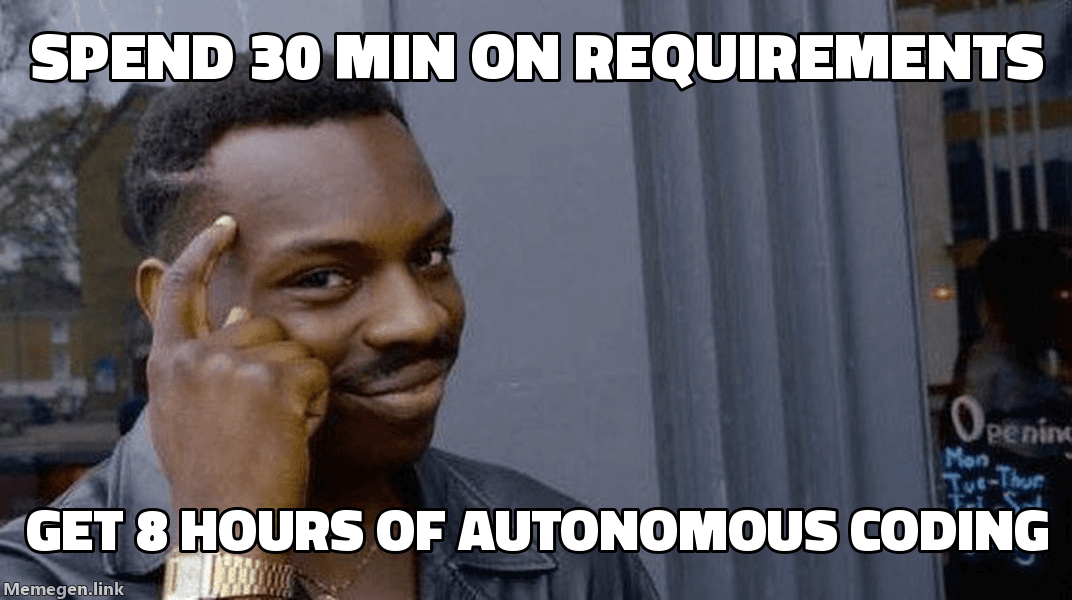
Spend at least 30 minutes talking through requirements with Claude before writing any code. Seriously. This conversation is where you catch the "oh wait, what about..." moments that would otherwise derail your autonomous build.
What Goes in Specs Files
Create specs/*.md files that become the source of truth. Don't overthink the format—focus on clarity:
Tip: If you want a structured approach to requirements gathering, check out JeredBlu's PRD Creator—a conversational prompt system that guides you through creating comprehensive specs.
specs/├── authentication.md # Login, JWT, sessions├── api-design.md # Endpoints, request/response formats├── database.md # Schema, relationships└── testing.md # Coverage requirements, test strategy
The Conversation That Matters
Here's how a good requirements conversation flows:
You: "I want to build a REST API for managing todos"Claude: "Let's break this down. What operations do you need?"You: "CRUD operations - create, read, update, delete todos"Claude: "Got it. What about authentication? User accounts?"You: "Yes, users should only see their own todos"Claude: "Makes sense. How should we handle..."
This back-and-forth surfaces edge cases you wouldn't think of alone. After the conversation, Claude generates structured specs documenting everything discussed.
The investment pays off: 30 minutes of requirements conversation prevents hours of Ralph spinning on ambiguous goals.
Phase 2: Planning
This is a separate mode using PROMPT_plan.md. You run planning mode explicitly when you need to generate or regenerate your implementation plan.
Planning mode does gap analysis between specs and code, creating a prioritized TODO list without any implementation or commits.
Two Ways to Run Ralph
There are two methods for running Ralph loops, and understanding when to use each is critical:
Plugin Method (/ralph-loop) — Runs iterations within a single context window. Easier to set up, good for shorter tasks (under 20-30 iterations).
Bash Loop Method (loop.sh) — Launches a fresh Claude instance per iteration. As Geoffrey Huntley's original guide explains, each iteration "deterministically loads the same files and reads the current state from disk." This prevents context bloat and hallucination that can occur when running many iterations in a single context. See community examples: snarktank/ralph.sh, frankbria/ralph_loop.sh, peteristhegreat's gist.
Why fresh context matters: The plugin runs everything in one context window, which fills up over time. After 30-40 iterations, Claude may start ignoring parts of your prompt or making inconsistent decisions. The bash loop method avoids this by starting fresh each time—the only shared state is what's written to disk (your code,
IMPLEMENTATION_PLAN.md, andprogress.txt). For advanced techniques, see Advanced Context Engineering for Coding Agents.
We'll show you how to create loop.sh in The Bash Loop Script section below.
How to Run Planning Mode
For planning, the plugin method works well since you only need ~5 iterations (context bloat isn't a concern):
/ralph-loop "$(cat PROMPT_plan.md)" --max-iterations 5 --completion-promise "PLAN COMPLETE"
Or using the bash loop (see The Bash Loop Script below):
./loop.sh plan
PROMPT_plan.md Template
Here's the complete template for planning mode. For real-world examples, see ClaytonFarr's PROMPT_plan.md or snarktank's prompt.md.
# PLANNING MODEYou are in PLANNING mode. Your job is analysis, not implementation.## Your Task1. Read all files in specs/2. Review the existing codebase in src/3. Perform gap analysis between requirements and current implementation4. Create/update IMPLEMENTATION_PLAN.md with prioritized tasks## Task StructureEach task in the plan should include:- Unique ID (e.g., TASK-001, TASK-002)- Priority level (high/medium/low)- Clear description (what needs to be built)- Acceptance criteria (how you'll know it's done)- Required tests (specific test files or patterns)- Dependencies (tasks that must complete first)## File OrganizationOrganize tasks by priority:- High Priority: Critical path items- Medium Priority: Important but not blocking- Low Priority: Nice-to-haves## Critical Rules- DO NOT write any code- DO NOT make any commits- DO NOT implement features- DO NOT run tests or builds- ONLY analyze and planWhen complete, output "PLAN COMPLETE"
See real examples: Browse actual prompt files from the community:
- snarktank/ralph — Complete prompt.md with AGENTS.md
- ClaytonFarr/ralph-playbook — PROMPT_plan.md template
- frankbria/ralph-claude-code — Implementation with exit detection
What Planning Produces
Planning mode generates:
IMPLEMENTATION_PLAN.md - Your living TODO list
Example structure:
# Implementation Plan## High Priority### TASK-001: User Authentication- **Status**: pending- **Description**: Implement JWT-based auth with login/logout- **Acceptance Criteria**:- User can register with email/password- User can login and receive JWT token- Protected routes require valid JWT- **Tests**: `auth.test.ts`- **Dependencies**: none### TASK-002: Todo CRUD Endpoints- **Status**: pending- **Description**: Create POST, GET, PUT, DELETE endpoints for todos- **Acceptance Criteria**:- POST /api/todos creates a todo- GET /api/todos returns user's todos- PUT /api/todos/:id updates a todo- DELETE /api/todos/:id deletes a todo- **Tests**: `todos.test.ts`- **Dependencies**: TASK-001## Medium Priority### TASK-003: Input Validation- **Status**: pending- **Description**: Add Zod validation for all endpoints...
Important: As The Ralph Playbook notes, the plan is disposable. If it becomes stale or inaccurate, delete it and regenerate by running planning mode again.
Phase 3: Building
This is the continuous loop mode using PROMPT_build.md. This is where Ralph shines—autonomously implementing tasks while you sleep.
What is backpressure? In the Ralph methodology, backpressure refers to automated validation mechanisms—tests, type checks, linters, builds—that reject unacceptable work. Instead of prescribing exactly how Claude should implement something, you create "gates" that reject bad output. Failing tests force Claude to iterate until the code is correct. This is the core insight behind autonomous coding loops.
Building mode assumes the plan exists, picks one task at a time, implements it with tests, commits, then loops with fresh context.
How to Run Building Mode
Quick start with the plugin:
/ralph-loop "$(cat PROMPT_build.md)" --max-iterations 50 --completion-promise "ALL TASKS COMPLETE"
For long-running builds (recommended): Use the bash loop method for fresh context per iteration. After setting up loop.sh (shown below):
./loop.sh # Default mode is building./loop.sh build 100 # With custom iteration limit
PROMPT_build.md Template
Here's the complete template for building mode. For real-world examples, see ClaytonFarr's PROMPT_build.md or frankbria's PROMPT.md.
# BUILDING MODEYou are in BUILDING mode. Your job is implementation with quality gates.## Your Task LoopFor each iteration:1. Read IMPLEMENTATION_PLAN.md and progress.txt2. Pick the SINGLE highest priority task with status: pending3. Study existing code before implementing4. Implement the feature completely5. Write comprehensive tests6. Run all tests and type checks: npm test && npm run type-check7. If tests fail, fix them immediately—DO NOT proceed8. When all tests pass:- Commit with descriptive message format: "feat(area): description"- Update task status to completed in IMPLEMENTATION_PLAN.md- Append learnings to progress.txt with timestamp## Critical Rules- Work on ONE task at a time—no exceptions- NEVER commit failing tests- NEVER skip test execution- Tests are your backpressure—respect them- Each commit must be atomic and working- Don't add features not in the plan- Don't refactor unrelated code## Backpressure EnforcementTests MUST pass before committing:```bashnpm test && npm run type-check && npm run lint```If any check fails, fix it in the same iteration.## Progress TrackingAfter completing each task, append to progress.txt:```[YYYY-MM-DD HH:MM] Completed TASK-XXX: Task Title- What was implemented- Key decisions made- Challenges encountered- Learnings for next tasks```When all tasks show status: completed, output "ALL TASKS COMPLETE"
See real examples: Browse actual PROMPT_build.md implementations:
- ClaytonFarr/ralph-playbook — PROMPT_build.md template
- frankbria/ralph-claude-code — Implementation with intelligent exit detection
- mikeyobrien/ralph-orchestrator — Enhanced orchestration implementation
Deep dive: Geoffrey Huntley's Don't Waste Your Back Pressure explains why validation and rejection mechanisms are critical for autonomous loops.
The Bash Loop Script
Here's a loop.sh script that supports both planning and building modes. This pattern comes from JeredBlu's guide and Geoffrey Huntley's original approach:
#!/bin/bash# loop.sh - Fresh context per iterationMODE=${1:-build} # Default to build modeMAX_ITERATIONS=${2:-50}if [[ "$MODE" == "plan" ]]; thenPROMPT_FILE="PROMPT_plan.md"COMPLETION="PLAN COMPLETE"MAX_ITERATIONS=${2:-5} # Planning needs fewer iterationselsePROMPT_FILE="PROMPT_build.md"COMPLETION="ALL TASKS COMPLETE"fiecho "Running in $MODE mode with max $MAX_ITERATIONS iterations"echo "Using prompt: $PROMPT_FILE"echo "Completion signal: $COMPLETION"echo "=========================================="for ((i=1; i<=$MAX_ITERATIONS; i++)); doecho "Iteration $i / $MAX_ITERATIONS"echo "--------------------------------"# The -p flag runs Claude in one-shot mode (see Mastery Part 1: https://jocv.dev/blog/claude-code-mastery-01-getting-started#one-shot-mode-quick-questions)result=$(claude -p "$(cat $PROMPT_FILE)" --output-format text 2>&1) || trueecho "$result"if [[ "$result" == *"$COMPLETION"* ]]; thenecho "=========================================="echo "$MODE complete after $i iterations."exit 0fiecho "--- End of iteration $i ---"doneecho "Reached max iterations ($MAX_ITERATIONS)"exit 1
Make it executable:
chmod +x loop.sh
Usage:
./loop.sh plan # Run planning mode (default 5 iterations)./loop.sh build # Run building mode (default 50 iterations)./loop.sh # Same as ./loop.sh build./loop.sh build 30 # Building mode with 30 iterations max
This gives you fresh context per iteration, preventing the context bloat that can occur with the plugin method on long runs.
For more sophisticated implementations with error handling, logging, and parallel execution, see snarktank/ralph and mikeyobrien/ralph-orchestrator.
The Building Loop Flow
As 11 Tips for AI Coding with Ralph Wiggum documents:
- Pick highest priority task from
IMPLEMENTATION_PLAN.md - Implement the feature
- Run all tests and type checks (backpressure!)
- Commit only if everything passes
- Update
progress.txtwith learnings - Loop with fresh context → repeat
Key insight: Each iteration runs in a fresh context window (with the bash loop method). This prevents context degradation and keeps Claude focused.
Complete Three-Phase Workflow
Here's how it all flows together (using the loop.sh script from the previous section):
# Phase 1: Define Requirements (conversational, not looped)# Talk with Claude to create specs/*.md files# Example: specs/authentication.md, specs/api-design.md, specs/database.md# Phase 2: Generate Plan (run once, or when plan needs refresh)./loop.sh plan# Or with the plugin: /ralph-loop "$(cat PROMPT_plan.md)" --max-iterations 5 --completion-promise "PLAN COMPLETE"# Creates IMPLEMENTATION_PLAN.md with prioritized tasks# Phase 3: Build Autonomously (continuous loop)./loop.sh# Or with the plugin: /ralph-loop "$(cat PROMPT_build.md)" --max-iterations 50 --completion-promise "ALL TASKS COMPLETE"# Implements tasks one by one, commits, loops# When plan becomes stale (features changed, new requirements):rm IMPLEMENTATION_PLAN.md./loop.sh plan # Regenerate plan./loop.sh # Resume building
File Structure
Your project should have this structure:
your-project/├── specs/│ ├── authentication.md│ ├── api-design.md│ ├── database.md│ └── testing.md├── PROMPT_plan.md # Planning mode prompt├── PROMPT_build.md # Building mode prompt├── IMPLEMENTATION_PLAN.md # Generated by planning, updated by building├── progress.txt # Append-only log of learnings├── loop.sh # Bash orchestrator script└── src/ # Your actual code├── api/├── auth/└── tests/
Key Differences Between Modes
Planning Mode:
- Prompt file:
PROMPT_plan.md - Goal: Analyze & plan
- Makes commits? No
- Writes code? No
- Runs tests? No
- Updates plan? Yes (creates/overwrites)
- Typical iterations: 1-5
- Run when? Once, or when refreshing plan
Building Mode:
- Prompt file:
PROMPT_build.md - Goal: Implement & test
- Makes commits? Yes
- Writes code? Yes
- Runs tests? Yes
- Updates plan? Yes (marks tasks complete)
- Typical iterations: 20-100+
- Run when? Continuously until done
Essential Files for Long-Running Ralph Loops
progress.txt
Track what's been accomplished across iterations. As The Ralph Playbook explains: "The progress.txt is a standard long-running agent practice. Feed it to the agent via the prompt, and use the verb 'append' to make sure it doesn't update previous entries."
Ralph reads this to understand context without re-exploring the codebase.
How to use it:
In your prompt, instruct the agent to:"After each task, APPEND (don't overwrite) your learnings to progress.txt"
Example progress.txt entry:
[2026-01-16 14:30] Completed TASK-001: User Authentication- Implemented JWT signing/verification using jsonwebtoken- Added httpOnly cookie storage for tokens- All auth tests passing (12/12)- Learning: Cookie sameSite setting needed for cross-origin requests- Challenge: Had to debug token expiry edge case- Next: Tackle TASK-002 (Todo CRUD endpoints)
IMPLEMENTATION_PLAN.md
Your living TODO list that Ralph updates as it completes tasks. This file bridges Planning and Building modes.
Structure:
# Implementation Plan## High Priority- [ ] TASK-001: User Authentication (status: pending)- Tests: auth.test.ts- Dependencies: none## Medium Priority- [ ] TASK-002: Todo CRUD (status: pending)- Tests: todos.test.ts- Dependencies: TASK-001## Completed- [x] TASK-000: Project Setup (status: completed)- Completed: 2026-01-15 22:00
Writing Effective Ralph Prompts
Critical Prompt Elements
As documented in 11 Tips for AI Coding with Ralph Wiggum, every Ralph prompt should include these elements:
Progress Tracking:
Read progress.txt to see what's been accomplished.After completing each task, APPEND (never overwrite) your progress.
Backpressure Through Testing:
Each commit MUST pass all tests and type checks.Run: npm test && npm run type-check && npm run lintIf anything fails, fix it before moving on.NEVER commit broken code.
Scope Control:
Pick the SINGLE highest priority task from IMPLEMENTATION_PLAN.md.Work ONLY on that task—don't add features or refactor unrelated code.
Exploration First:
Study the codebase first.Don't assume something isn't implemented—verify by reading files.Use ultrathink before making changes.
Language Patterns That Work
Based on community learnings from The Ralph Wiggum Playbook and 11 Tips, these phrases improve Claude's behavior:
- "Study the codebase first" → Reduces assumptions about what exists
- "Don't assume not implemented" → Encourages verification before writing
- "Ultrathink before acting" → Promotes careful planning before changes (
ultrathinkallocates maximum thinking budget for complex reasoning—see Mastery Part 9) - "Capture the why in commits" → Improves git history quality
- "MUST pass all tests" → Enforces quality gates strictly
What's Next
You now have the professional methodology: specs for requirements, planning mode for gap analysis, building mode for autonomous execution. The file structure. The prompt templates.
In Part 3: Ralph TUI Monitoring, we'll cover real-time visibility for long-running loops—dashboards, keyboard controls, and session management.
Then in Part 4: Advanced Patterns & Troubleshooting, we dive into advanced prompt engineering, common pitfalls, comprehensive troubleshooting, and enterprise-grade patterns.
Phase 1: Requirements — Talk with Claude, create specs/*.md files
Phase 2: Planning — Read-only loop: /ralph-loop "$(cat PROMPT_plan.md)" --max-iterations 5 --completion-promise "PLAN COMPLETE"
Phase 3: Building — Autonomous loop: /ralph-loop "$(cat PROMPT_build.md)" --max-iterations 50 --completion-promise "ALL TASKS COMPLETE"
When plan becomes stale
rm IMPLEMENTATION_PLAN.md then re-run planning mode
Key takeaways
Three phases with separate prompts: specs, planning, building
Planning mode generates the roadmap—no code, no commits
Building mode implements one task at a time
Tests are your backpressure—Ralph can't commit broken code
progress.txt preserves learnings across iterations
Plans are disposable—regenerate when stale
Atomic tasks work best—self-contained tasks that can complete in 2-3 iterations with clear pass/fail verification
Stay Updated
Get notified about new posts on automation, productivity tips, indie hacking, and web3.
No spam, ever. Unsubscribe anytime.